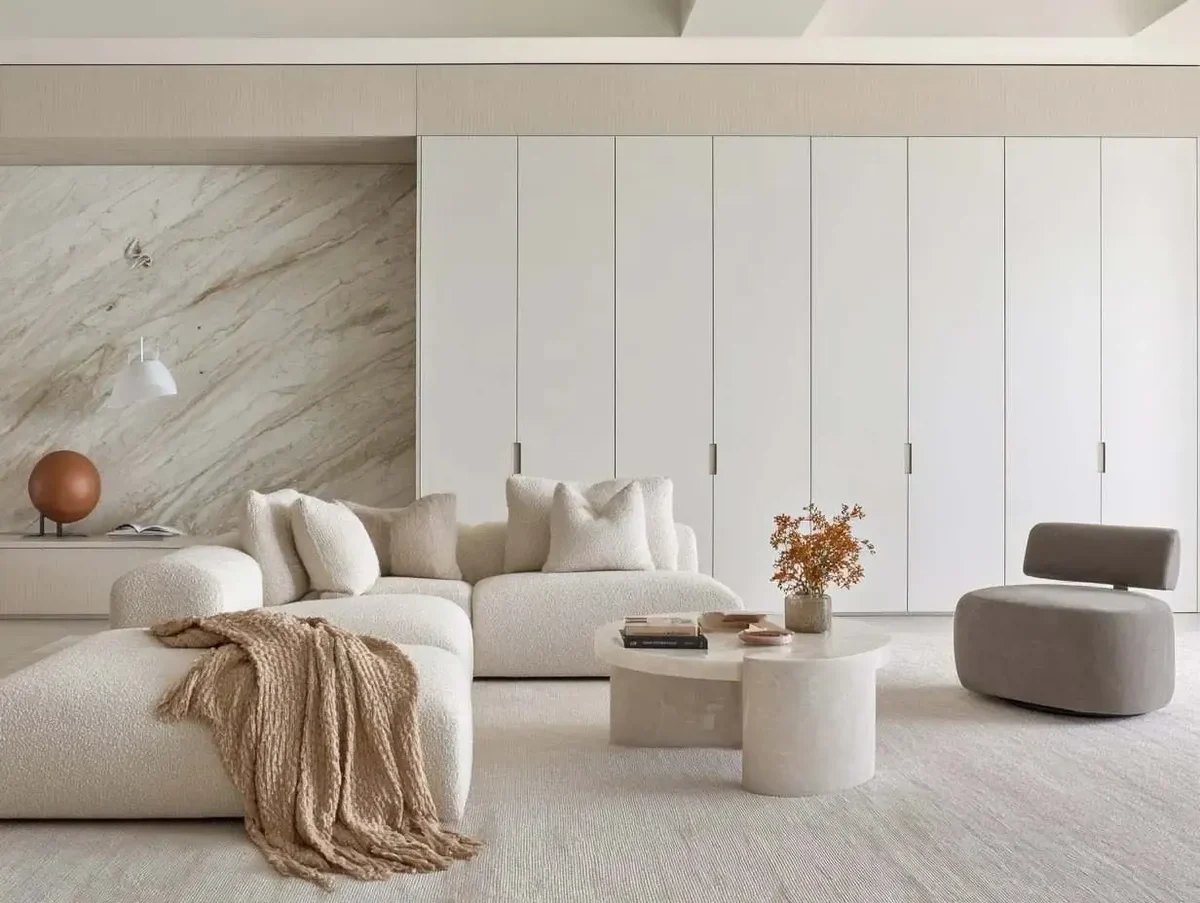
Natural living room design (sometimes called biophilic design) from interior designer Joelle Uzyel, built in three layers: natural light first, then a material palette of solid wood, natural linen, travertine, organic fiber rugs, and Roman clay walls, with plant selection last. How the room comes together in Beverly Hills, Bel Air, and Malibu projects, and what is actually worth buying.
A natural living room is built in three layers: natural light first, natural materials second, plants last. Most people start with the plants and wonder why the room does not work.
The material palette that carries the room: solid wood, natural Belgian linen, travertine or limestone, hand-knotted organic fiber rugs, and Roman clay walls.
One sculptural specimen tree in a terracotta or stone vessel does more than a dozen small plants on shelves.
Natural light is the first material. Unblocked windows, unlined linen sheers, and warm 2700K artificial light change a room before a single piece of furniture does.
Roman clay costs the same as regular paint and reads as a $15,000 plaster wall treatment from across the room.
Natural, organic living room design is one of the most searched looks in residential interiors right now, and most of what ranks for it is wrong. It gets reduced to a fiddle-leaf fig and a rattan chair, decoration wearing a philosophy's name. The real thing is sensory: stone that grounds you, wood grain that makes you stop and look, linen that breathes, light that moves across a plaster wall through the day. People want to walk into a living room and feel it. Natural materials and natural light do that. Plants finish it.
A natural living room is designed in three layers. Natural light first: unblocked windows, linen sheers, warm artificial light at 2700K. Materials second: solid wood, natural linen, travertine or limestone, organic fiber rugs, and Roman clay walls. Plants last: one or two sculptural specimens in stone or terracotta vessels. Get the first two layers right and the room feels connected to nature before a single plant arrives.
Across $250M+ in completed residential projects in Beverly Hills, Bel Air, Malibu, and Miami Beach, I have specified every iteration of this movement, before it was called biophilic, through the organic modern wave, and into what it has become now: a mature, material-driven approach to residential interiors that rewards investment. This guide covers how I design a natural living room, layer by layer: the light, the full material palette, the plants, and how it comes together in real projects.
Natural, organic design is a philosophy, not a look. In interior design it means building a living room that creates a real sensory connection to the natural world through light, material, texture, form, and living plants. Organic modern is the style most people picture when they search for it. This is the deeper commitment underneath: real stone instead of stone-look porcelain, solid wood instead of veneer, natural fiber instead of synthetic blends, daylight treated as a design material instead of an afterthought.
The living room is where this philosophy earns its keep. It is the room where you spend your waking hours at home, the room guests read first, and the room where synthetic materials fail fastest. Most design trends are cyclical. Natural design is not one of them. It is a response to a specific cultural moment: overexposure to screens, a renewed interest in wellness-forward environments, and a generation of homeowners in Beverly Hills and Miami Beach who have lived through enough design cycles to know that a room full of synthetic materials will feel dated within three years. Natural materials do not age out.
The shift that distinguishes the current moment from the organic modern wave of 2020 to 2022 is specificity. Clients are no longer satisfied with gesture. They want real stone, not stone-look porcelain. They want solid walnut, not walnut veneer over MDF. They want Belgian linen, not a polyester blend marketed as breathable. That demand for authenticity is what makes material literacy the most valuable skill a designer can offer right now.
Natural materials do not age out. A burl wood coffee table from 1965 reads as more current today than a lacquer-and-chrome piece from 2010.
Every natural living room I design starts with the light, not the furniture. Daylight is the one material in the room that changes hour by hour, and it is the strongest connection to nature the room will ever have. Before any purchase, do the unglamorous work: clear the windows. Take down heavy lined drapery, move furniture out of the sightline to the glass, and if the room looks onto anything green, a garden, a courtyard, a single tree, arrange the primary seating so it faces that view rather than the television wall.
The window treatment for a natural living room is an unlined sheer in natural linen. It filters light without blocking it, moves with air, and turns hard afternoon sun into something soft enough to live in. Blackout belongs in bedrooms. In a living room it reads as a hotel corridor. Where privacy demands more, layer a linen sheer under a natural-weave drapery panel and keep the panels stacked off the glass during the day.
Artificial light has to hold the same standard after dark. The specification is 2700K, everything on dimmers, and at least three sources at different heights: a floor or table lamp at seated eye level, a low accent on the stone or wood surface, and one source raking across the textured wall so the Roman clay reads at night the way it does at four in the afternoon. Cool white light is the fastest way to undo every natural material in the room.
Unlined linen sheers: Full-height, generously gathered, hung from as close to the ceiling as the architecture allows. The linen filters daylight into the soft, moving quality that makes natural materials read correctly. Lined drapery kills it.
2700K on dimmers, no exceptions: Every bulb in the room at 2700K, every circuit dimmable. Mixed color temperatures in one sightline is the fastest way to make a considered room look cheap. Warm light is what stone, wood, and linen were meant to be seen in.
Three heights of light: One source at seated eye level, one low accent near the stone or wood surface, one raking the textured wall. Overhead recessed cans alone flatten every material in the room. In a natural living room they are fill, never the plan.
With the light handled, the material palette carries the rest of the room. This is where the contemporary living room and natural materials became inseparable: the cleaner the architecture, the more the surfaces have to do. Five materials do the work. Solid wood, most powerfully burl, for the anchor piece. Natural Belgian linen for upholstery. Travertine or unfilled limestone for the stone moment. Hand-knotted wool or jute underfoot. Roman clay on at least one wall.
The palette holds to a narrow tonal range on purpose: flax, oatmeal, cream, honey, warm brown, clay. Color in a natural living room comes from the materials themselves, not from a paint deck. When every surface is a natural material in a natural tone, the room reads as calm and collected rather than beige. Texture does the job pattern usually does.
Each of the five materials has its own rules, its own tells for quality, and its own places to buy well. The next five sections cover them one at a time.
Burl wood is what happens when a tree experiences stress or disease and responds by developing a dense, irregular growth formation. The resulting grain is impossible to replicate. No two burl pieces are identical. The swirling, almost marbled patterns range from walnut burl, which reads dark and sophisticated, to white oak burl, which has a lighter, more sculptural quality. Both belong in a natural living room.
The right burl piece for a living room is a coffee table or side table at a scale that commands attention without overwhelming the room. Burl works at contrast: place it beside natural linen and the grain becomes the focal point. Pair it with travertine and you have a material conversation that reads as collected and intentional. Do not crowd burl with too many other statement pieces. Give it space. That is how it performs.
Solid slab over veneer: Burl veneer over MDF is how budget furniture fakes the look. Solid burl slabs are the investment. The weight, the edge profile, and the way the grain continues through the thickness are all tells. If a price point seems low for solid burl, it is not solid burl.
Oil-finished over lacquered: A lacquered burl table reads as protected. An oil-finished burl table reads as alive. The oil penetrates the grain and keeps it tactile, which is the entire point. High-gloss lacquer on burl is a decorator move, not a designer one.
Walnut burl for warmth, white oak burl for restraint: Walnut burl is darker, richer, and more dramatic. It belongs in rooms with high ceilings and strong architecture. White oak burl is quieter and pairs well with the lighter palette that dominates contemporary Beverly Hills and Malibu residential work. If in doubt, white oak is the more versatile specification.
RH (current stone and burl collection), Arhaus (Maguire and Atlas tables), and custom millwork are the investment tier. CB2 and Lulu and Georgia carry accessible options. For the most interesting pieces at any price, buy vintage through Chairish and 1stDibs.
Linen is the upholstery I specify most consistently across projects in Beverly Hills and Miami Beach, and the pushback from clients is always the same: it wrinkles, it stains, it is harder to clean than performance fabric. All of this is true. It is also beside the point. Linen is the only upholstery material that gets better as it ages. It develops a patina. It drapes with a looseness that synthetic alternatives can only approximate. In a natural living room, that natural aging is not a liability. It is the whole idea.
The distinction that matters most in this category is Belgian linen over generic linen blends. Belgian linen is tighter-woven, more durable, and has a natural sheen that does not photograph as flat. For a true design specification, the source is a fabric house: Kravet, Romo, and Libeco are the names that matter.
Belgian linen over standard linen blends: Standard linen blends are 50 to 70 percent linen mixed with polyester or cotton. They do not drape the same way, do not develop the same patina, and are not worth the premium price most mid-tier brands charge for them. Belgian linen, tightly woven and fully natural, is the specification. Libeco is the supplier name to know.
Natural undyed over dyed linen: The most enduring linen sofas in my projects are in natural undyed linen: oatmeal, flax, stone. These tones carry forward through every design refresh. A dyed linen sofa in a specific green or dusty rose is a commitment to a moment in time. The natural undyed versions are permanent.
Slipcover construction for living rooms: A tailored slipcover in Belgian linen is both a design and practical choice. It can be laundered, adjusted, and replaced without reupholstering. For living rooms with heavy use, slipcover construction is the professional specification.
Marble is not wrong. Marble in a Beverly Hills project reads as expected. Travertine reads as considered. The shift toward travertine and unfilled limestone in high-end residential work over the past three years is a recognition that the vein-heavy, dramatic marbles that dominated the previous decade had a specific visual loudness that natural design actively rejects. Travertine is quieter. Its pitting, its warm cream-to-honey tones, and its matte surface connect to the natural world in a way that polished Calacatta does not.
For a natural living room, travertine belongs on the coffee table surface, on a side table, as a sculptural bowl or object, or as a floor material that runs from interior to exterior. The unfilled travertine, where the natural voids and pockets are left open rather than grouted flush, is the specification that reads as most connected to the material's actual geology. It requires sealing and more careful maintenance, but the result is a surface that looks alive.
Travertine coffee table: The travertine coffee table is the most requested stone piece in current living room projects. Look for a solid slab top, not travertine tile assembled on a substrate. The single-slab surface is what reads as high-end. RH and CB2 both carry versions; the quality difference is primarily in edge profile and base material.
Limestone side table or pedestal: A turned limestone pedestal used as a side table or plant stand is a natural specification that also functions as sculpture. The material is dense, cool to the touch, and develops a subtle patina with handling. Serena and Lily and McGee and Co. carry accessible versions.
Stone objects: A travertine or limestone bowl, a raw stone sphere, or a carved stone candleholder placed on a burl surface creates a material conversation that no styled object can replicate. Anthropologie, CB2, and independent ceramic studios all carry this category at various price points.
The rug is the foundation material in a natural living room. It is also the category where the difference between a $400 piece and a $4,000 piece is immediately and undeniably visible. Pile height, knot density, natural dye depth, and the way the rug holds its shape under furniture are all qualities that communicate themselves the moment you walk into a room.
The natural specification for a rug is hand-knotted wool, hand-woven jute, or a flat-weave in a natural fiber. Wool is warm, forgiving, and deeply tactile. Jute is cooler, more architectural, and has a graphic quality that reads well in open-plan spaces. The wrong choice is a machine-made synthetic marketed with natural-sounding fiber names. That category does not belong in a natural space.
Primary living room: hand-knotted wool. The investment living room rug is hand-knotted wool, sourced from Morocco, Iran, or a domestic studio like Loloi's higher tiers or Arhaus's handmade collection. Size first: the rug should extend past the legs of the primary seating on all sides. An undersized rug in a beautiful material still reads as wrong.
Secondary seating or open-plan: natural fiber flat-weave. For the zone under a console or beneath a reading chair, a flat-weave in jute, sisal, or seagrass provides natural texture without competing with the primary wool rug. Layer the flat-weave beneath the wool for the stacked-rug look that is consistent across high-end Beverly Hills and Malibu projects right now.
Where to source: Arhaus, Serena and Lily, and McGee and Co. carry accessible hand-knotted and natural fiber options. For an investment rug that functions as a collection piece, Jaipur Living, Loloi II, and vintage Moroccan through Chairish are the categories I shop.
Size and knot density are the two specifications that separate a rug that anchors a room from one that disappears under it.
Venetian plaster is the correct specification for a natural living room wall when budget supports it. It is also a skilled-labor application that costs between $8 and $20 per square foot installed depending on the market. In Beverly Hills and Malibu, that cost is justified. For every project where Venetian plaster is specified, there are three where Roman clay delivers 80 percent of the same result at a fraction of the cost.
Roman clay, most notably Portola Paints' Roman Clay line, is a thick-bodied, matte, trowel-applied finish that reads as organic and architectural in the best way possible. It breathes naturally, develops a subtle variation and depth, and applied in warm whites or clay tones, it is the wall treatment that makes a natural room feel complete without adding a single piece of furniture.
Investment: Venetian plaster. True Venetian plaster, applied in three or more coats by a skilled artisan and burnished to a polished depth, is the highest-tier wall specification in a natural room. It reads as architecture, not decor. The investment is per square foot, and it justifies itself in every room where it is applied.
Primary specification: Roman clay. Portola Paints Roman Clay is the current specification I return to most. The color families that work best in a natural context: White Cliffs, Raw Silk, and Warm Stone. Apply over any primed wall surface with a Japanese drywall knife in overlapping passes. The second coat, slightly off-angle from the first, creates the depth.
Accessible: Limewash paint. Portola Lime Wash and Romabio Classico Limewash both perform well in secondary rooms and rentals. They do not replicate the depth of true Roman clay, but they are DIY-applicable and a significant step above flat paint in a natural context.
Plants come last in natural living room design, and they are singular, not plural. The move is one sculptural specimen tree placed where the light supports it, in a vessel that belongs to the material palette. One seven-foot olive tree in a terracotta pot does more for a room than twelve small plants distributed across shelves and sills. The tree reads as a living architectural element. The shelf of small plants reads as a collection that needs watering.
The vessel matters as much as the plant. Terracotta, aged and unsealed, or carved stone. Never a visible plastic nursery pot, never a glazed pot in a color that fights the palette. On species, be honest about your light. An olive tree in a dark corner is a slow-motion loss. If the corner is dark, specify for the corner you have, not the one on the mood board.
Olive tree: the natural living room specification. Silvery, sculptural, and quiet. It needs the brightest spot in the room, ideally near south- or west-facing glass, and it wants to dry out between waterings. In terracotta, it is the single most consistent plant specification across my California projects.
Ficus Audrey over fiddle-leaf fig: The fiddle-leaf fig is the plant everyone buys and everyone kills. Ficus Audrey delivers the same scale and presence with more forgiveness: it tolerates a missed watering and adapts to bright indirect light. If you want a tall broadleaf tree indoors, this is the one.
Bird of paradise for scale: In double-height living rooms, most plants disappear. A mature bird of paradise holds its own against tall architecture, and its broad leaves cast the kind of moving shadow that makes a room feel alive at dusk.
Low light, told straight: For genuinely dark rooms: a large snake plant or a ZZ plant in a stone vessel. Neither is a showpiece. Both stay alive and read as intentional. A thriving modest plant always beats a dying dramatic one, and one good faux olive beats both if no one will water it. Default to real.
One specimen per room. Terracotta or stone. Placed where the light actually is. That is the entire plant strategy.
In a Beverly Hills residence, the living room brief was calm without emptiness. The answer was material, not furniture count: a white oak burl coffee table as the anchor, an undyed Belgian linen sectional with slipcover construction, Roman clay in a warm white on the fireplace wall, and a single olive tree at the south-facing glass. Nothing in the room announces itself. Everything in the room holds up to touch.
In a Bel Air estate with a double-height living room, scale was the problem. Small natural gestures vanish in tall architecture. There, the natural layer had to be structural: travertine flooring running uninterrupted from the living room to the terrace so the ground plane itself connects inside to outside, a hand-knotted Moroccan wool rug to hold the seating zone, and a pair of mature birds of paradise doing the work that art would normally do.
In a Malibu oceanfront villa, the nature was already there. The design problem was staying out of its way. Unlined linen sheers on every opening, limestone surfaces that pick up the tone of the bluff outside, jute layered under wool, and no specimen tree at all. When the view is the Pacific, the natural move is restraint.
Rooms like these are built through my full-service interior design practice, where the natural layer is drawn into the architecture, the lighting plan, and the material schedule from day one rather than styled in at the end.
Filling the room with plants before choosing materials: Plants are the last layer in a natural living room, not the first. A room full of plants on top of synthetic materials and lacquered surfaces does not read as natural. It reads as a nursery. The plant adds life; the material adds weight. Get the material palette right first.
Buying stone-look porcelain instead of actual stone: Stone-look porcelain is an excellent material for a bathroom floor. It is not a substitute for natural stone on a living room coffee table or side surface. The reflectivity is wrong, the edge profile is wrong, and the weight difference is detectable. Natural materials communicate themselves through touch and physical presence.
Choosing burl veneer over MDF to save on budget: Burl veneer applied over a composite substrate is how mass-market brands get the visual. The swirling grain is there. The substance is not. If the budget does not support solid burl, buy a vintage piece through Chairish. Do not buy the simulation.
Undersizing the rug: An undersized rug is the most common and most visible mistake in a living room. The rug should extend at least 18 inches past the front legs of the primary sofa. For a typical Beverly Hills or Malibu living room, this means a minimum of 9-by-12 feet in the primary seating zone.
Blocking the light the room depends on: Heavy lined drapery, furniture pushed against the glass, and cool white bulbs undo every natural material in the room. Daylight is the first natural material. Treat the windows as the most valuable surface in the room, because they are.
Mixing too many natural materials at the same visual weight: Burl, travertine, jute, Roman clay, and linen are all strong materials with their own visual language. The editing principle: one hero material per surface category. Let each material breathe or the room reads as a showroom sample floor, not a designed space.
A natural living room is not a room you complete in one purchase. It is a room you build in sequence. The order I use with clients: light first, because it costs the least and changes the most. Then the floor covering, then upholstery, then the stone accent, then the burl piece, then Roman clay on one wall. The specimen tree arrives last, once the room has earned it.
The pieces below are the current specifications I return to most across projects. They span price points because natural design is a material philosophy, not a budget category. A hand-knotted Moroccan rug from Chairish and Roman clay from Portola read as expensive as a full RH specification, if the editing is correct. The editing is the work.
Every piece in this category is available through my ShopMy collection below. These are not sponsored recommendations. These are the pieces I actually specify. And if you want the room designed rather than assembled, my interior design services cover the full scope, from lighting plan to material schedule to install.
Natural living room design is the practice of designing a living room around a sensory connection to nature: natural light, natural materials, organic texture, and living plants. It is a philosophy, not a plant count. The room is built in three layers. Light first: unblocked windows, linen sheers, warm artificial light. Materials second: solid wood, natural linen, travertine or limestone, organic fiber rugs, and clay or plaster walls. Plants last: one or two sculptural specimens in stone or terracotta vessels.
Design the light first: clear the windows, hang unlined linen sheers instead of heavy drapery, and keep artificial light warm at 2700K on dimmers. Build the material palette second: hand-knotted wool or jute on the floor, natural Belgian linen upholstery, a solid wood piece such as burl, a travertine or limestone accent, and Roman clay on at least one wall. Add plants last: one large sculptural specimen such as an olive tree or Ficus Audrey in a terracotta or stone vessel.
The five natural materials that deliver the most impact in a natural living room are: burl wood (coffee table or side table), natural Belgian linen (sofa or primary seating upholstery), travertine or unfilled limestone (stone accent surface), hand-knotted wool or natural fiber jute (area rug), and Roman clay or Venetian plaster (feature wall). Each of these materials ages well, connects to nature at a sensory level, and holds its design relevance across multiple trend cycles.
No. Plants are the last layer of natural design, not the foundation. One sculptural specimen tree, an olive tree or Ficus Audrey in a terracotta or stone vessel, does more for a living room than a dozen small plants on shelves. A room full of plants over synthetic materials reads as a nursery, not a natural space. Material selection and natural light carry the room; plants finish it.
Organic modern design is a visual style: curved silhouettes, warm neutrals, sculptural forms, and natural materials used as aesthetic choices. Natural design is a philosophy: spaces designed to create a measurable sensory and psychological connection to the natural world through material, light, texture, and form. Every natural living room is organic modern. Not every organic modern room reaches that depth. The distinction is depth of material commitment.
Natural linen is one of the best living room sofa materials for a natural, material-driven space. Belgian linen develops a patina with age and drapes with a looseness that performance fabrics cannot replicate. It wrinkles and shows use, but in a natural living room that aging is the point. For heavy-use rooms, specify a tailored slipcover in undyed Belgian linen so it can be laundered and refreshed.
Burl wood is at the peak of its current design moment in 2026. More importantly, burl wood is not a trend in the way that lacquered acrylic or mirrored furniture are trends. It is a natural material with centuries of use in fine furniture, and a piece of well-crafted solid burl holds its value and visual relevance across design cycles. A burl coffee table purchased in 2026 will read as current in 2036.
Joelle Uzyel Interior Design specializes in natural-materials, organic modern, and warm minimalist residential interiors across Beverly Hills, Bel Air, Malibu, and the greater Los Angeles area, as well as Miami Beach and New York. With over $250M in completed residential projects and features in Architectural Digest and Elle, the firm takes on a limited number of full-service projects each year. Inquiries can be made at joelleuzyel.com/contact.